When researching into documentaries, I found out that there are many different types of documentaries:
Poetic
It shows a form of expression and it targets a personal subject with the people on the screen. This type of documentary enhances a variety of elements through the type of music used which develops the mood and tone, through the editing and also through the cinematography of the documentary.
Expository
These documentaries aren't necessarily fictional. It's a piece that directly speaks to the viewers and creates a strong sense of argument. They try to persuade the viewers, but not everything shown may be real and relevant to the subject.
Observational
It provides an outside perceptive that looks in onto a particular subject. Usually it will be something that is not dramatized or staged, like 'One Born Every Minute'. The content of the programme is reality and also fully factual with no changes made. Therefore it is a fully observational documentary.
Participatory
It is a documentary that is slightly similar to a 'Expository' documentary which means that the subject that is being discussed and questioned may be influenced on the screen through the Director, Producer or Presenter.
Reflexive
It's a documentary that clearly shows the behind the scenes so the filming, editing and everything in between. This means that the audience can make their own judgement on what is happening.
Performative
This is a piece that can be emotional as it targets a personal experience and/or subject which is usually developed by the filmmaker. It allows the audience to gain a perspective of something that is then questioned by themselves.
By knowing these different types of documentaries, it will me when making our documentary as I will know what sort of content to include and how to structure it.
For our 'On Location' workshop, we visited Faversham after it being visited and approved by Helen. We were then split into groups of 4 - 2 groups will be walking around the market and the other 2 groups will be walking around the brewery.
I was in one of the groups that walked around the market place - I was in a group with Nisserin and Josh. We decided that Josh would start as the camera man and we would take turns in filming different shots and in the different locations that we were allowed to visit.
We started by filming a beginning shot to set the scene and the location, and then we moved around the market and shot a variety of different scenes such as the public walking along the street, people looking at stalls, people handing money to the stall owner and a busker who at the time was singing and playing his guitar to the public.
We decided that actuality close up shots of the public being natural in that environment would show the market well and you would be able to get a good sense of the atmosphere.
We also got some shots of the old landmark buildings that were in the street, and we shot these on the tripod so we would get static shots that we could cut into.
After doing some wandering around the street we found a little hotel, and one of the owners was more then happy to do a little interview with us. We then shot a few nature shots by the creek, including a goose and some nice landscape shots.
When editing the video we wanted to make it fun and interesting, and we did this through the music and the pace of the cuts. We made sure to include the hotel to create the friendliness of the town, and we added some cutaways of the market.
I thought that our final edit gave the market a nice feel and it was fun to watch. Helen's feedback was we needed different music, which was a fair point, and we needed to have more shots on the tripod.
From this workshop I have learnt that most shots need to be filmed on the tripod to make it stable and balanced and to make the video look more professional and documentary like.
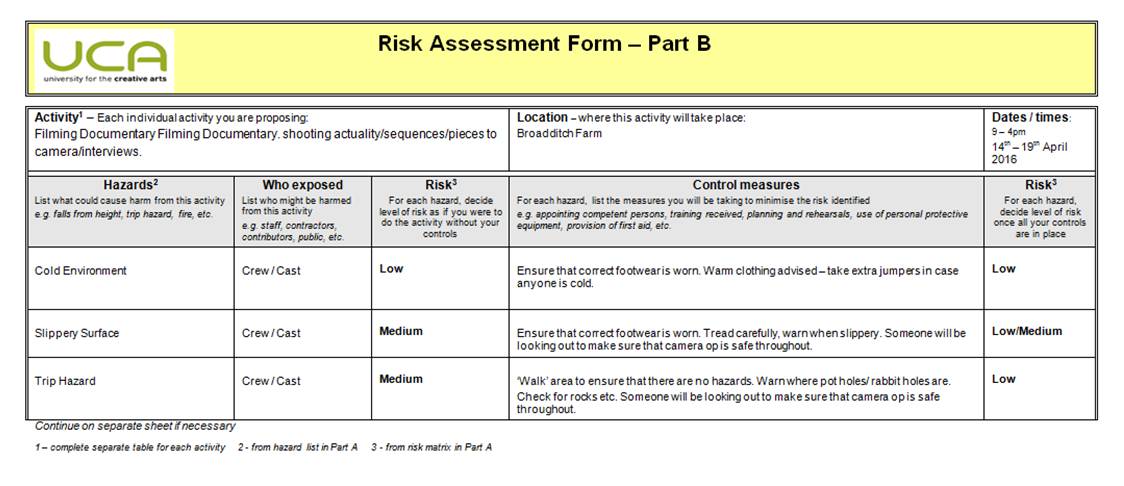
Here is the risk assessment for the creek:
Here is the risk assessment for the market:
Here are the two consent forms we had the busker and the hotel owner fill out:
Here is the call sheet for our first filming day - Thursday 14th April. One of my jobs within the group was to write the call sheets for the day, and this is the outcome.
We discussed as a group, what time we should get to the location, what time we need the cast at the location and what roles everyone is going to have.
We decided that Nisserin would be the Producer and the Director, I would be the camera operator/Director of Photography, and Sammi would be the sound operator.
We wanted to get there fairly early so we would have time to set up the equipment and also so we could start early and get as much done as possible.
The crews call time is 9am and the cast's call time is 9:30am - 10am. Due to the farmers working on the day, we are going to work around their schedule, so when they are free to film we will make sure we are free as well.
This is the call sheet for the day we are planning on filming nature and wildlife:
This is the call sheet for the day we have kept free if we need to re film anything:
When we started thinking about what our documentary will look like, and what content will be in it, we got together and made a list. We started by creating a narrative, and during one of our tutorials with Helen she suggested we base our narrative around the timings during the day.
What she meant by that was, the beginning of the documentary will be set at the beginning of the day, and then the end of the documentary will be set at the end of the day. We all agreed that this was a good idea, so we planned out the order everything will be in while also deciding what questions we want the presenter to ask John, the farmer.
At first, it was my job to write the script, so I started by writing the commentary to help create a base for the script, but I found it quite hard to write it on my own as I wanted the rest of my group to have a say in what the script will be like. Also I found documentary scripts harder to write than normal scripts, so the others helped me.
We got together and started writing the script using all three of our opinions. After some discussions and moving some questions and shots around, we finished writing more than half of the script. Due to me not feeling confident enough to finish the script, we all decided that Sammi would finish the last part of the script.
Once the script was finished, Sammi showed it to Helen and the feedback we got was that some parts were in the wrong place and they needed to be moved around. Also some words needed to be changed but other than that, everything was good.
After the tutorial, we talked about the feedback and decided that Sammi would improve the script and then send it to myself and Nisserin so we could start the storyboard and the shot list.
After the sound workshop where I was interviewed, we were given the task to create a shot list and a script for it so we could film cut away shots, and then edit it together to create a final video. Due to some complications, myself and Nisserin were put in a group with Sammi, but we decided to use the footage from our workshop as both me and Nisserin were involved in the interview.
We wrote the script and then the shot list, and we also wrote out a list of cutaway shots that we needed to shoot to make the video effective and more like a documentary piece. Due to some of the interview being about my interests outside of university, we decided that getting together round my house, when we're not at uni, was a smart idea.
We then discussed filming in the base room at uni, and using some archive footage of my previous YouTube videos, as I do mention a similar topic within the interview.
At my house, we shot the clips of me playing the ukulele and singing, and we also filmed a shot of me typing on my laptop - scriptwriting - and editing a video.
This was to show my interest in editing videos, writing scripts and creative writing in general. We also shot some cutaway shots to show my interest in Disney & Giraffes.
Then at the studios we shot footage of me looking through the camera and taking pictures to show my interest in photography and the camera in general.
We then filmed me walking through the base room door and writing on a notebook to emphasise the creative writing interest.
The archive footage we used was me performing in front of an audience a few years ago. We also used some clips of my previous videos on YouTube, and some of the videos I produced while at uni.
While editing this video we started by looking through the interview footage and cutting out the stuff we didn't want like the pauses and the fillers. We watched through the interview and placed the cutaway footage on top of the interview whenever it was appropriate.
We decided not to add background music as we felt it would distract the audience from the interview itself, and also we had a clip of me singing later on in the video, so we needed no sound before and after hearing it. Once it was done we added credits, and we colour corrected the clips to make all of the clips match and to keep the continuity of the shots.
This workshop really helped me with the development of editing and filming a documentary. I realised that a lot of cutaway shots are used within documentaries to help tell the story, and also to keep the audience interested.
This helped, also, with the structuring of my groups documentary as it can give us ideas on how we want to present the footage, and how we want the interview to look.